
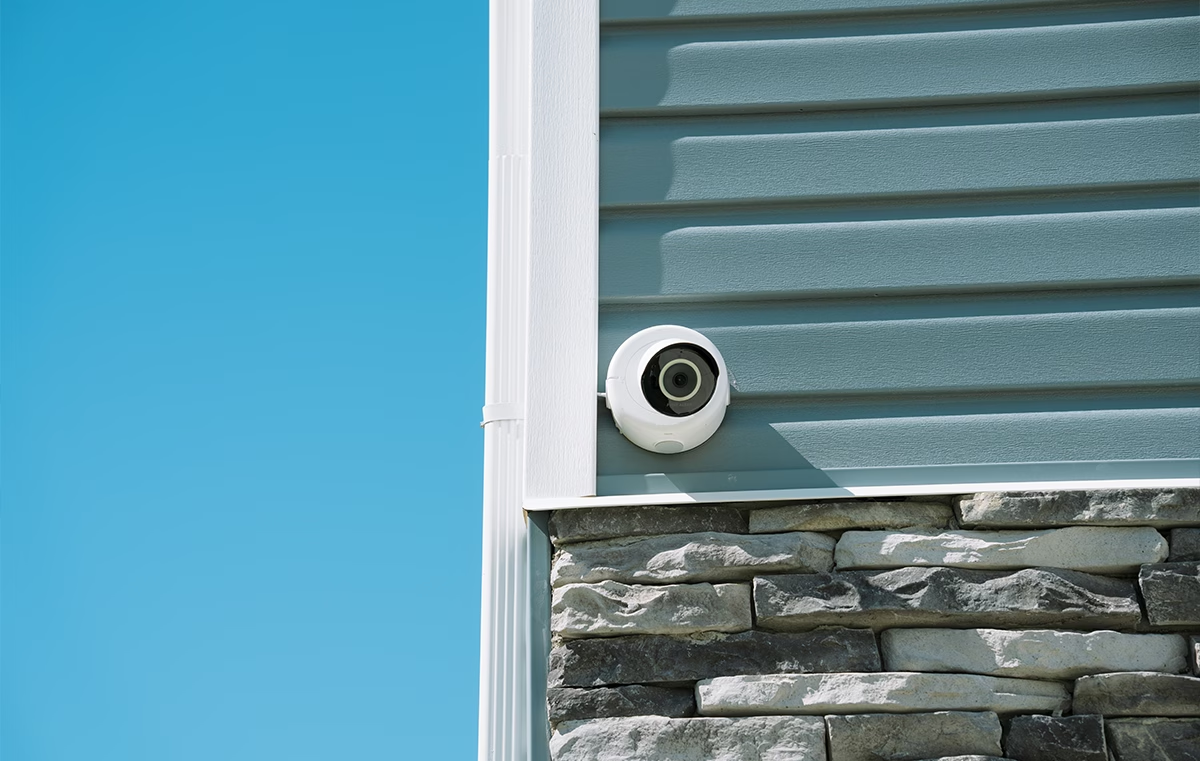
Here’s a scenario most facility managers in East Tennessee know too well. A door opens after hours. The alarm goes off. But the camera covering that door is on a different system, so nobody sees who walked in until someone digs through footage the next morning. Meanwhile, the alarm couldn’t tell anyone whether it was a break-in, a late delivery, or a raccoon on the loading dock.
The gear works fine. But the trouble is that none of it talks to each other, and that gap is why businesses across the region are walking away from standalone setups in 2026. This is why integrated security systems—the single platform combining video, access control, intrusion, and fire—are quietly becoming the regional standard.
The old way simply costs too much in money, time, and missed moments.
The Hidden Cost of Going Standalone
When your security tools each run on their own island, the cracks show up in familiar ways:
- The false alarms never stop: A standalone motion sensor can’t confirm what it’s seeing, so wind, weather, wildlife, and a delivery van all set it off. Each one still costs you a response.
- Your team stops listening: When every sensor cries “wolf” on its own, people tune them out, including, if it happens, the one alert that actually matters.
- Footage hides when you need it most: The access log lives in one place and the camera lives in another. They never talk, so the clip you need is the clip nobody thinks to look for until it’s too late.
- The bills quietly add up: Every false trip can mean a truck roll. Every employee who leaves means re-keying by hand. Every real incident means piecing together separate logs after the fact.
For a business running more than one location, none of this stays small. The same gap exists at every site, all at once.
Integrated Security in Action
The idea is simpler than it sounds. Integrated security puts video, access control, intrusion, and fire on a single platform with unified monitoring, so the pieces work together instead of guessing in the dark. The Cybersecurity and Infrastructure Security Agency points out that connecting physical security functions this way sharpens both threat detection and coordinated response across a facility.
On the ground, that means
- Remote monitoring that gives you one dashboard for every location, instead of a different login for each.
- Access control that hands out and pulls back permissions by credential, which is a lifesaver in multi-tenant buildings where access changes constantly.
- Manufacturing security that ties perimeter detection straight into camera response, built for a floor that never sleeps.
- Multi-tenant protection that keeps shared spaces covered while respecting each tenant’s privacy.
- Multi-location management that runs every property from one view, with the same standards everywhere.
The thread tying it all together: your system stops being a drawer full of disconnected gadgets and starts behaving like one team that talks to itself.
What Integration Saves You
| What you’re measuring | Standalone system | Integrated system |
| False alarms | Frequent false positives | Sensors confirm a threat before alerting |
| Truck rolls | High, with plenty of wasted trips | Fewer, thanks to remote verification |
| Re-keying | Manual and slow | Digital credentials revoked instantly |
| Incident response | Slow, with the full picture missing | Fast, because the data lines up |
Industry research suggests that verified, video-confirmed alarms are one of the biggest drivers of lower false-dispatch rates and quicker response times. The savings tend to show up in the places nobody tracks until they add it all up, like the dispatches that never had to happen and the incidents resolved in minutes instead of days.
Integrated Security That Knows East Tennessee
For more than 50 years, Fleenor Security has designed and serviced integrated commercial systems across East Tennessee, with local technicians on the ground and licensing across Tennessee, Virginia, and North Carolina. That regional history is what makes integration work in the real world. The system gets built around how your facility actually runs, with the regional knowledge to back it up.
Ready to close the gaps? Request an integrated security assessment for your facility at Fleenor Security Systems.