
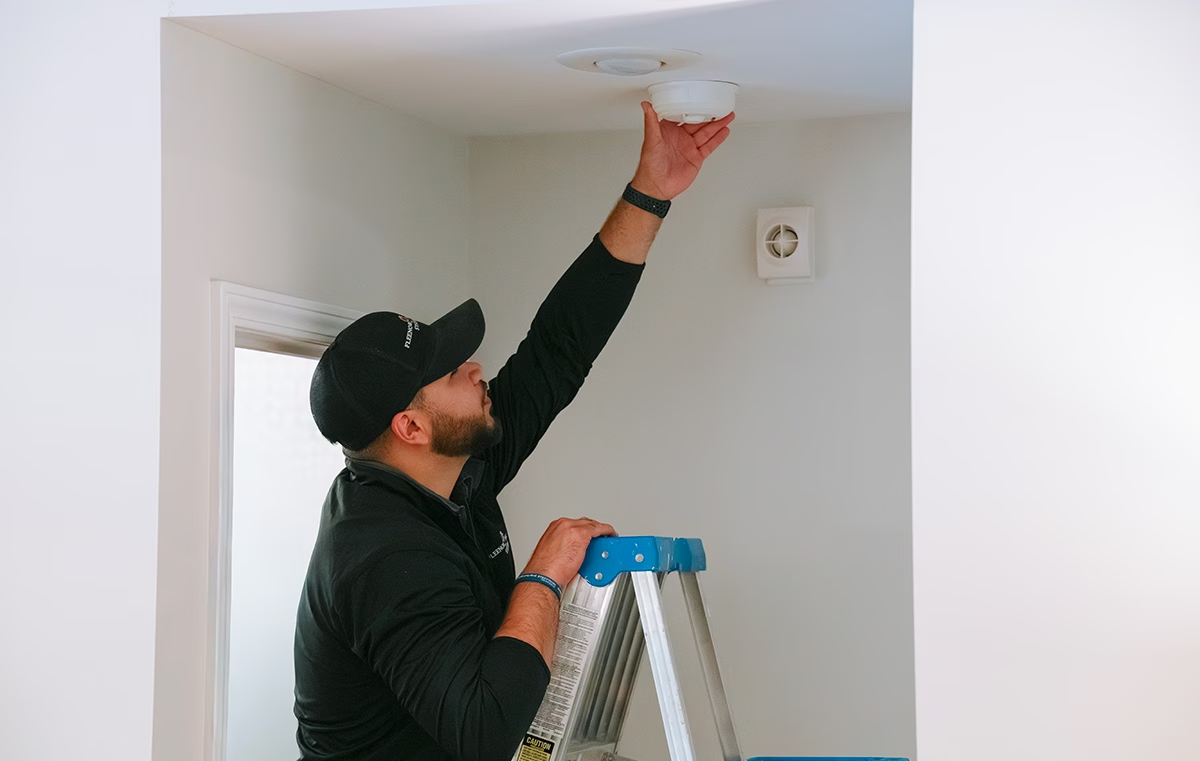
Fall is the natural time to take stock of fire protection. Heating equipment comes back on, fireplaces see their first use in months, and Tennessee businesses head into a season of insurance renewals and occupancy reviews that bring fire safety front and center. For homeowners, the shift is quieter but no less important: a smoke detector that hasn’t been tested since last year, a CO alarm running on aging batteries, a monitoring connection no one has verified since installation.
A fire alarm inspection in Tennessee confirms that the protection standing between your family or your employees and an emergency actually works.
| Not sure whether your home or business is covered? Schedule a fire protection evaluation with Fleenor Security, your local security company serving Knoxville and Johnson City for over 50 years. |
What a Fire Alarm Inspection Confirms
At its simplest, an inspection answers one question: if a fire starts, will your system do its job? For a home, that means testing every smoke and CO detector, checking manufacture dates, and confirming coverage on every level and outside every sleeping area. The National Fire Protection Association recommends testing alarms monthly, replacing batteries yearly, and replacing the units themselves every ten years. That ten-year mark is the one most people miss, because alarms don’t visibly wear out even as their sensors lose reliability with age.
For a business, the inspection is more formal. Tennessee follows NFPA 72, the National Fire Alarm and Signaling Code, as enforced by the State Fire Marshal’s Office and local authorities having jurisdiction. A qualified, licensed contractor checks the initiating devices, tests the horns and strobes, verifies the control panel and battery backup, and confirms that auxiliary functions like door release and HVAC shutdown perform as designed. For most commercial properties, that inspection happens annually, and the documentation supports insurance renewals, occupancy reviews, and fire marshal inquiries.
The through-line for both is the same. A working system is not the one that was installed years ago. It’s the one that’s been verified recently.
Fire Alarm Inspection Requirements by Property Type
Exact inspection requirements vary by jurisdiction and occupancy. As a general pattern:
| Property Type | Typical Inspection Frequency | Governing Standard / Authority | Licensed Contractor Required? |
|---|---|---|---|
| Residential (single‑family) | Monthly homeowner tests; professional as needed | NFPA 72 guidance/State Fire Marshal | Recommended |
| Multi‑family residential | Annual professional inspection | NFPA 72/local AHJ | Yes |
| Commercial (retail, office) | Annual inspection | NFPA 72/TN Fire Marshal/local AHJ | Yes |
| Healthcare/educational | Annual, with additional components per code | NFPA 72/ healthcare/education codes/AHJ | Yes |
| Manufacturing/industrial | Annual inspection | NFPA 72/OSHA‑related requirements/AHJ | Yes |
Note: Local authorities having jurisdiction may impose stricter requirements than state minimums. Confirm with your local fire marshal or a licensed contractor for the requirements specific to your municipality and occupancy type.
Why Monitored Systems Change the Equation
Standalone smoke and CO alarms meet code minimums, and they are far better than nothing. But they share one limitation: they depend on someone being present to hear them and act.
A monitored system removes that dependency. Whether the alarm trips in an occupied home in the afternoon or an empty facility overnight, the response is the same. A trained operator at a UL-listed monitoring center receives the signal, attempts contact, and dispatches the fire department if no one responds or if the situation calls for it. That difference matters most in the moments no one is watching: an unoccupied second home, a warehouse after hours, or a bedroom during sleep, when carbon monoxide can be dangerous before anyone wakes.
For businesses, the case is practical as well as protective. Many commercial carriers offer premium reductions for monitored fire systems backed by documented annual inspections, and that same documentation demonstrates due diligence if a claim is ever filed.
Fall Is the Right Time to Find Out What Your System Can Do
For homeowners, readiness starts with testing and replacing aging detectors before heating season. For businesses, it means scheduling the annual inspection before year-end deadlines arrive. Either way, the process starts with a conversation about what you have now and where the gaps are.
If you’re evaluating your current fire protection or need to schedule a commercial inspection, the process starts with a conversation. Learn more about how Fleenor approaches fire and security for commercial properties, or schedule an evaluation directly.
Schedule a fire protection evaluation:
Knoxville: (865) 544‑9964 | Johnson City: (423) 282‑3755
Request a fire protection evaluation online, residential and commercial, no obligation.
Fire Alarm Inspection FAQ
How often should smoke detectors be tested?
Test every alarm monthly using the test button, replace batteries at least once a year or whenever you hear a low-battery chirp, and replace the entire unit every ten years.
Does Tennessee law require CO detectors in the home?
Carbon monoxide requirements are set by state building codes and local authorities having jurisdiction. Homes with fuel-burning appliances, attached garages, or fireplaces are a priority, and many codes require alarms in these settings. The State Fire Marshal’s Office maintains current guidance.
What’s the difference between a monitored and unmonitored fire alarm?
An unmonitored alarm only alerts whoever is present. A monitored alarm connects to a central station that attempts contact and dispatches the fire department when needed, whether or not anyone is home.
Can one security company monitor both fire and intrusion?
Yes. For most commercial properties, integrating fire, intrusion, access control, and surveillance through a single provider is more reliable than managing separate vendors.